


WarriorCollective
Kickboxing Sparring Drills - Developing Fighters with Mick Crossland
Kickboxing Sparring Drills - Developing Fighters with Mick Crossland
Couldn't load pickup availability


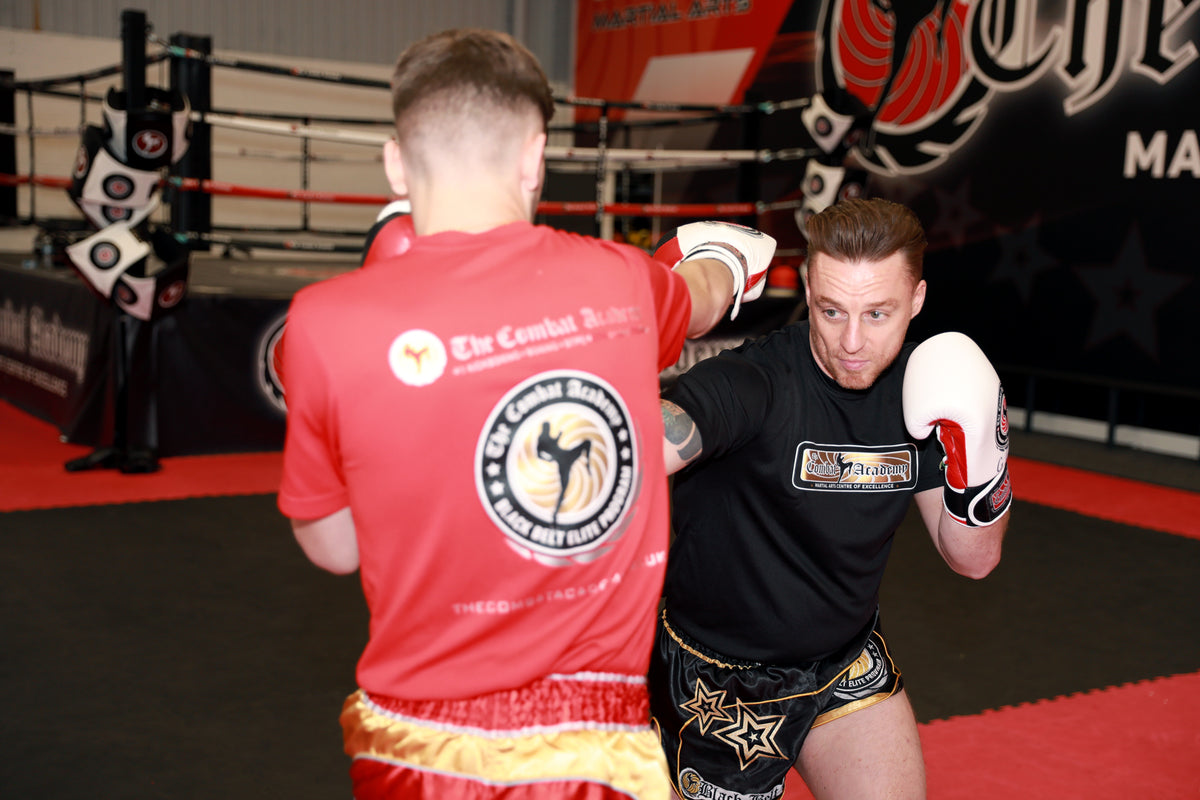

Kickboxing Sparring Drills – Developing Fighters with Mick Crossland
Learn Kickboxing sparring drills and fighter-development systems with World Champion Kickboxer and elite striking coach Mick Crossland. Discover how structured sparring can develop timing, reactions, distance control, shot selection, defence, counter striking and intelligent decision-making in fighters.
Kickboxing Sparring Drills – Developing Fighters is the second full-length Warrior Collective instructional from Mick Crossland, founder and Chief Instructor of The Combat Academy and one of the UK's most experienced Kickboxing coaches.
Where Mick's first instructional, Advanced Kickboxing Drills – How to Fight at Elite Level, establishes many of the technical and tactical concepts behind his approach to fighting, this second volume explores the next stage:
How do you turn those skills into something a fighter can actually use against a resisting opponent?
The answer isn't simply more open sparring.
Mick demonstrates how carefully designed Kickboxing sparring drills, restricted rounds and progressive training constraints can be used to isolate individual problems before gradually adding greater freedom, pressure and unpredictability.
Across the instructional you'll study:
The 5 Disciplines of Fighter Development
Isolation Sparring Drills
Intercepting Attacks
Defend & Counter Drills
Defensive Positioning
Shot Selection
Combination Development
Sparring Entries
Power-Side Leads
Countering Kicks
Parrying & Redirection
Boxing Drills
and Elite Fighter Development.
Rather than sparring simply becoming two fighters exchanging techniques, Mick shows how it can become one of the most powerful tools available to a coach for systematically developing better fighters.

Sparring Should Develop Fighters – Not Just Test Them
There is an important difference between doing sparring and using sparring to develop a fighter.
Put two Kickboxers together and tell them to spar and they will certainly gain experience.
But they may also repeatedly fall back on the techniques they already favour.
Avoid situations they find difficult.
Repeat the same mistakes.
Rely on physical attributes.
Or become increasingly good at one particular type of sparring without actually addressing weaknesses in their overall game.
Mick Crossland approaches sparring differently.
Instead of every round being completely open, he demonstrates how coaches can manipulate the rules, ranges, weapons, objectives and problems within a round to encourage particular behaviours.
Want a fighter to improve their interception?
Create rounds that force them to recognise forward pressure.
Want better defence and counters?
Restrict the exchange so those decisions repeatedly occur.
Want better shot selection?
Create situations where the fighter has to recognise which weapons are available at a particular range.
Want them to become better at entering safely?
Build rounds around solving that exact problem.
The fighter still has to make decisions against a resisting opponent – but the training environment increases the number of opportunities they get to practise the skill you actually want to develop.
Over time, restrictions can be removed and those skills can be integrated back into increasingly open sparring.
This is the central value of this instructional.
Mick isn't simply giving you sparring drills. He's showing you how to use sparring as a coaching system.

Mick Crossland – World Champion Fighter & Elite Kickboxing Coach
Mick Crossland is a former World Champion Kickboxer and the founder and Chief Instructor of The Combat Academy in Barnsley, UK.
With more than 30 years of Martial Arts experience across Kickboxing, Boxing, Muay Thai and Karate, Mick competed internationally throughout his own fighting career and accumulated an extensive list of amateur and professional achievements.
These include:
-
Multiple Yorkshire, English, British, European and International amateur titles
-
English Professional Kickboxing Champion
-
Two-time British Professional Champion
-
European Professional Champion
-
World Professional Champion
-
1st Dan Black Belt in Freestyle Karate
-
4th Dan Black Belt in Kickboxing
But Mick's development as a coach is just as important as his achievements as a fighter.
Through The Combat Academy, he has gone on to produce more than 40 recognised champions from Area through to World level, with fighters succeeding across K-1, Full Contact, Low Kick and other competitive Kickboxing formats.
That experience has required Mick to do much more than teach techniques.
He has had to develop fighters.
And that means understanding how to take a student from learning individual skills through to being capable of recognising situations, solving problems and making effective decisions under the pressure of live competition.
This instructional provides an unusually detailed look at that process.


The Combat Academy – A System for Long-Term Fighter Development
Based in Barnsley, The Combat Academy has developed into one of the UK's most established Kickboxing organisations.
Its flagship Barnsley academy combines a large recreational Martial Arts programme with an established competitive pathway, allowing students to begin training with no experience and progressively develop towards increasingly advanced levels of performance.
That progression is reflected throughout Mick's coaching.
Rather than treating every student like an already accomplished fighter, skills are developed progressively.
Fundamentals come first.
Individual skills are isolated.
Problems are introduced.
Resistance increases.
Decision-making becomes more important.
Sparring becomes increasingly open.
And eventually the fighter has to put everything together against an opponent who is actively trying to prevent them from succeeding.
The results can be seen across generations of Combat Academy fighters who have competed successfully under different Kickboxing rule sets.
Kickboxing Sparring Drills – Developing Fighters explores the stage where technical knowledge starts becoming functional fighting ability.

What you will learn
1. The 5 Disciplines
Mick begins by establishing a principle-led framework for fighter development.
Rather than treating Kickboxing as an endless collection of individual techniques, the aim is to understand the different areas a fighter needs to develop and how training can be structured around them.
This gives coaches a framework for identifying what a fighter needs rather than simply deciding which drill to perform next.
2. Isolation Sparring Drills
One of the central themes of the instructional is isolation.
Mick demonstrates how individual ranges, techniques, tactical problems and concepts can be isolated within sparring.
Restricting the available options gives fighters more opportunities to experience a particular situation.
Instead of a problem occurring once during five minutes of open sparring, the drill can make it occur repeatedly.
This creates an environment where fighters can experiment, recognise patterns and develop solutions against genuine resistance.
3. Building Rules into Sparring
Restrictions don't make sparring less realistic when they're used correctly.
They make the learning objective more concentrated.
Mick explains how rules can be introduced into rounds to encourage specific skills and behaviours before progressively removing those restrictions.
For coaches, this provides a powerful method for designing sparring around the development needs of individual fighters.
4. Intercepting Attacks
Aggressive opponents want to establish momentum.
Mick explores how fighters can learn to recognise forward movement and intercept attacks before the opponent is able to establish their preferred combinations.
Rather than simply retreating or waiting to defend the completed attack, fighters develop the confidence to disrupt opponents as they enter.
5. Defend & Counter
Defence becomes considerably more valuable when it creates offence.
Mick uses structured drills to develop the relationship between the defensive action and the counter that follows it.
Instead of defending, resetting and then attacking again, fighters learn to recognise opportunities to turn an opponent's offence immediately into their own offence.
6. Defensive Positioning
Good defence isn't only about blocking punches and kicks.
Where you position yourself affects the opponent's ability to attack in the first place.
Mick examines how distance and defensive positioning can help fighters manage pressure, move safely and avoid becoming overwhelmed by aggressive opponents.
This helps develop fighters who aren't simply capable of defending techniques – they're better at avoiding bad situations altogether.
7. Shot Selection
Having more techniques doesn't automatically create a better fighter.
Choosing the right technique at the right moment is considerably more important.
Mick breaks down how sparring drills can help fighters recognise which weapons are appropriate at different ranges and stages of an exchange.
This develops one of the hardest attributes to teach through static drilling alone:
decision-making.
8. Combination Development
Combinations need to work against people who are actively trying to defend them.
Mick demonstrates drills that allow both sides of the exchange to develop simultaneously.
One fighter learns how to construct and deliver combinations.
The other develops their ability to read, defend and respond.
Rather than passive drilling, both training partners have a clear developmental objective.
9. Sparring Entries
Entering into striking range always carries risk.
An opponent can counter as you step forward, intercept your attack or move away and force you to overreach.
Mick explores ways to reduce those risks by developing better entries, positioning and angles.
The objective isn't simply to reach the opponent.
It's to enter in a position from which you can attack effectively without unnecessarily exposing yourself to the counter.
10. Power-Side Leads
Fighters commonly build attacks around their lead side before bringing their rear-side power weapons into play.
Mick examines ways of reversing that relationship and initiating exchanges with rear-side attacks.
These drills help fighters become less predictable and develop additional ways of bringing their most powerful weapons into the fight.
11. Countering Kicks
Kicks are among the longest weapons available in Kickboxing.
Mick explores ways to take those weapons away from an opponent by working both inside and outside the kick.
Rather than simply defending and resetting, fighters learn how their positioning can immediately create opportunities to counter.
12. Parrying & Redirection
Not every attack needs to be absorbed on a hard defensive structure.
Mick develops the use of parrying and redirection as part of a wider defensive framework.
These drills teach fighters to manipulate incoming attacks, alter their opponent's position and create opportunities to respond.
The result is a more active form of defence in which the fighter is constantly looking to turn the opponent's attack into an advantage.
13. Boxing Development for Kickboxing
Effective Boxing for Kickboxing isn't simply conventional Boxing performed while somebody is allowed to kick you.
Distance changes.
Stance changes.
Entries change.
Defensive choices change.
And the threat of kicks and knees affects how combinations can be constructed.
Mick uses Boxing-focused drills to develop the hands while keeping them relevant to the wider demands of Kickboxing.
14. Elite Fighter Development
The same fundamental drills don't necessarily need to disappear as a fighter becomes more advanced.
They need to evolve.
Mick demonstrates how baseline Kickboxing sparring drills can be layered with additional decisions, weapons, restrictions and tactical problems to challenge increasingly experienced fighters.
This is particularly valuable for coaches.
Rather than constantly searching for more complicated techniques, you learn how to make familiar training methods deeper, more demanding and more representative of the problems an elite fighter actually needs to solve.
Who Is This Instructional For?
Kickboxers
If you already know how to punch and kick but want to improve your ability to apply those techniques against resisting opponents, this instructional bridges the gap between technical training and open sparring.
K-1 Fighters
Develop the timing, distance, entries, interceptions, counters, shot selection and decision-making needed to apply your striking effectively under K-1-style rules.
Kickboxing Coaches
This is arguably where the instructional offers its greatest value. Mick provides a framework for creating purposeful sparring rounds rather than simply telling students to put their gloves on and fight.
Competitive Fighters
Use structured sparring to isolate weaknesses, develop specific tactical skills and progressively integrate them back into your complete game.
Martial Arts Instructors
Learn how restrictions, objectives and progressive resistance can transform familiar partner drills into much more effective fighter-development tools.

From Technique to Application
A fighter can look outstanding on the pads.
They can perform combinations perfectly during partner drills.
They can understand exactly what their coach wants them to do.
But none of that guarantees they'll recognise the same opportunity when another trained fighter is standing in front of them.
That transition from knowing a technique to being able to apply it is one of the hardest parts of Martial Arts development.
Structured sparring provides the bridge.
It retains the unpredictability and decision-making of live training while allowing the coach to influence which problems the fighter repeatedly encounters.
That makes this instructional particularly useful when combined with Mick's first Warrior Collective volume.

Continue the Mick Crossland Kickboxing Series
Be sure to scroll to the bottom of this page to discover the Mick Crossland Complete Bundle.
You'll receive both Warrior Collective instructionals in Mick's expanding Kickboxing series while saving compared to purchasing each volume individually.
Start with Advanced Kickboxing Drills – How to Fight at Elite Level, where Mick establishes his framework for defence, distance control, footwork, counter striking, interceptions, body attacks, southpaw strategy, systemised striking and pad work.
Then progress into Kickboxing Sparring Drills – Developing Fighters, where many of those technical and tactical ideas are developed against increasingly live and unpredictable resistance.
From advanced Kickboxing defence, distance control, footwork, counter striking, interceptions, body attacks and pad work through to structured sparring, shot selection, reactions and progressively developing skills against live resistance, the Complete Bundle provides an in-depth insight into the systematic approach Mick uses to develop intelligent, adaptable fighters at The Combat Academy.
Rather than simply providing more techniques and combinations, the series explores how to build those skills into a complete fighting system and then develop the timing, decision-making and adaptability required to make them work in sparring and competition.
Ideal for Kickboxers and coaches looking to study a progressive, competition-proven approach to K-1 Kickboxing and long-term fighter development.

Frequently Asked Questions
Are these Kickboxing sparring drills suitable for beginners?
Yes. One of the strengths of Mick's approach is that the difficulty of a sparring drill can be changed according to the experience of the fighter.
Beginners can work within tightly controlled rounds with limited weapons and clearly defined objectives, while more experienced fighters can progressively be given greater freedom and more complex problems to solve.
The instructional is particularly valuable for practitioners who already understand basic Kickboxing techniques and now want to improve their ability to apply them against a resisting opponent.
Is this instructional specifically for K-1 Kickboxing?
No. Although it is particularly relevant to K-1 Kickboxing, Mick has extensive experience across K-1, Full Contact, Low Kick and other competitive Kickboxing formats.
The underlying principles of distance, timing, defence, counter striking, shot selection, positioning and decision-making can therefore be adapted according to the rules under which you train or compete.
Is this instructional suitable for Kickboxing coaches?
Absolutely.
In many ways, coaches may gain even more from this instructional than fighters.
Rather than simply providing drills to copy, Mick demonstrates how to construct sparring environments around specific learning objectives.
That gives coaches a framework they can continue using long after they've worked through the individual drills shown in the instructional.
Why use restricted sparring instead of just open sparring?
Open sparring remains an important part of fighter development, but it doesn't guarantee that a particular weakness or tactical problem will occur frequently enough for a fighter to improve it.
Restricted sparring allows a coach to deliberately increase the frequency of particular situations.
Once the fighter becomes increasingly comfortable solving that problem, restrictions can progressively be removed until the skill is integrated back into open sparring.
What's the difference between this and Advanced Kickboxing Drills – How to Fight at Elite Level?
The two instructionals complement each other.
Advanced Kickboxing Drills – How to Fight at Elite Level establishes much of Mick's technical and tactical framework, including defence, distance, movement, counters, interceptions, body attacks, southpaw strategy and pad work.
Kickboxing Sparring Drills – Developing Fighters focuses much more heavily on turning those skills into functional fighting ability through structured sparring and progressive resistance.
Think of the first volume as helping you build the system and this second volume as helping you develop the fighter capable of applying it.
Who is Mick Crossland?
Mick Crossland is a former World Champion Kickboxer and founder and Chief Instructor of The Combat Academy in Barnsley, UK.
With more than 30 years of experience across Kickboxing, Boxing, Muay Thai and Karate, Mick won titles at English, British, European and World professional level during his competitive career.
As a coach, he has gone on to develop more than 40 recognised champions from Area through to World level across different Kickboxing disciplines.
His Warrior Collective instructionals provide an opportunity to study the systems, drills and coaching methodology behind that long-term fighter development.
Below is an extract from Video 7 – Power Side Leads.
In this section Mick demonstrates how fighters can develop the ability to initiate attacks from their rear power side, creating different entries and making their offence less predictable.