

Japanese Kickboxing vs Muay Thai: What’s the Difference?
Japanese Kickboxing vs Muay Thai: What Are the Differences?
Japanese Kickboxing vs Muay Thai: how different are these two striking systems, and what can fighters learn from each?
At first glance, they have a great deal in common.
Both use punches, kicks and knees. Both reward timing, distance, balance and effective combination striking. Both have also influenced modern Kickboxing and MMA.
Look deeper, however, and important differences begin to appear.
Rules, competitive culture and martial arts influences have encouraged different approaches to stance, kicking, Boxing, clinching, rhythm and combination development.
There is also considerable variation within both sports.
Not every Muay Thai fighter uses the same stance or tactics. Neither does every Japanese Kickboxer.
The most useful comparison is therefore not about declaring one style better.
It is about understanding why certain technical and tactical characteristics appear more frequently within each system.

Japanese Kickboxing vs Muay Thai: The Main Difference
One of the biggest differences comes from the rules under which fighters compete.
Muay Thai allows punches, kicks, knees and elbows alongside extensive clinch fighting.
K-1-style Kickboxing also allows punches, kicks and knees, but elbows are prohibited and clinch interaction is considerably more restricted.
That distinction has important consequences.
A Muay Thai fighter can develop an entire area of their game around clinching, knees and elbows.
A Japanese Kickboxer competing under K-1-style rules needs to work within a format that encourages relatively rapid continuation of open striking exchanges.
Over time, different rules naturally encourage different solutions.
This helps explain many of the technical differences discussed below.
1. Stance and Movement
Muay Thai
Muay Thai stances vary considerably between fighters.
However, traditional approaches frequently favour an upright posture that allows the fighter to kick, check, knee and enter the clinch effectively.
Balance is extremely important.
The fighter needs to remain capable of attacking and defending without unnecessarily compromising their position.
Different styles of Muay Thai can then adapt that foundation according to the fighter's preferred weapons and tactics.
Japanese Kickboxing
Japanese Kickboxing can display a wider influence from Karate and Boxing.
Some fighters use more pronounced movement, stance changes and explosive entries.
The shorter combination-focused exchanges associated with modern K-1 competition can also encourage rapid transitions between punching and kicking range.
The difference is therefore not simply:
Muay Thai = static
Japanese Kickboxing = mobile
That would be far too simplistic.
Instead, the competitive environment and martial arts influences can encourage different approaches to movement and distance.

2. Kicking Techniques
Kicking is fundamental to both systems.
The biggest difference is not that one kicks more than the other.
It is the range of influences behind the kicking mechanics.
Muay Thai
Muay Thai is renowned for powerful round kicks delivered to the legs, body and head.
The teep is another fundamental weapon.
It can control distance, disrupt balance, interrupt attacks and create opportunities for further offence.
Low kicks also play an important role.
Different Muay Thai fighters may emphasise power, timing, volume or tactical placement depending on their individual style.
Japanese Kickboxing
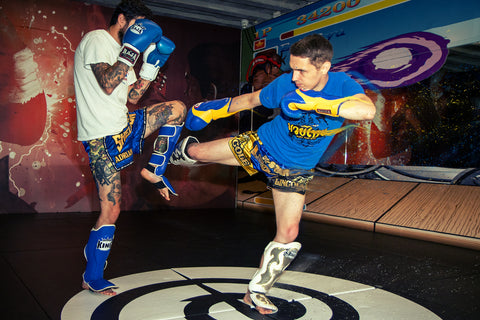
Japanese Kickboxing also uses conventional low, body and head kicks.
However, its Karate influence can introduce additional kicking mechanics and trajectories.
Depending on the fighter, these may include:
- Calf kicks
- Mikazuki kicks
- Snapping Karate-style kicks
- Unorthodox low kicks
- Front-leg attacks
- Spinning kicks
- Kicks from stance changes
These additional options can create different defensive problems.
Several attacks may begin from similar movements before travelling towards different targets.
This can make the final attack more difficult to recognise.
For a deeper examination of these techniques, read our complete guide to Japanese Kickboxing Techniques.
3. Boxing and Punching
Punching is important within both Muay Thai and Japanese Kickboxing.
However, the surrounding rules can influence how the hands are used.
Muay Thai
Punches form one part of Muay Thai's wider striking arsenal.
They can create openings for kicks, knees, elbows and clinch entries.
Some Muay Thai fighters are extremely Boxing-heavy, while others build their game more heavily around kicks, knees or clinching.
It would therefore be misleading to suggest that Muay Thai uses only basic Boxing.
The hands simply exist alongside a particularly wide selection of other weapons.
Japanese Kickboxing
Boxing can become especially prominent within modern Japanese Kickboxing combinations.
Punches can be used to enter range, create pressure and influence the opponent's guard before kicks or knees follow.
Japanese fighters with Karate backgrounds may also incorporate body-punching ideas developed through full-contact Karate.
The result can be a style in which Boxing and kicking are connected through rapid combinations.
Again, this varies considerably between fighters.
The important difference is the tactical environment in which those punches are being used.

4. Knees and Clinch Fighting
This is one of the clearest differences between Japanese Kickboxing and Muay Thai.
Muay Thai
The clinch is a major technical area within Muay Thai.
It can involve:
- Positioning
- Hand fighting
- Knees
- Elbows
- Off-balancing
- Sweeps
- Turns
- Breaking posture
- Controlling the opponent
Some fighters build a substantial part of their competitive style around clinch fighting.
Becoming skilled in Muay Thai therefore requires understanding what happens when the distance closes.
Japanese Kickboxing
Knees remain important within K-1-style Kickboxing.
However, the rules generally restrict prolonged clinching.
This changes how knees are incorporated.
They can appear during combinations, when intercepting forward movement or during brief close-range interactions.
The fighter cannot rely on extended clinch exchanges in the same way as a Muay Thai specialist.
That difference alone can significantly change how the two sports look tactically.

5. Elbows
Elbows provide another major distinction.
They are fundamental weapons within full-rules Muay Thai.
They can be used at close range, during entries and within clinch exchanges.
K-1-style Kickboxing does not permit elbows.
This changes both offence and defence.
A position that is relatively safe under Kickboxing rules may create very different risks when elbows become available.
Removing elbows also changes the range at which fighters can comfortably exchange.
This is another example of the rules shaping the technical style.
6. Combination Structure
Both systems use combinations.
However, the available weapons can influence how those combinations develop.
Muay Thai
Muay Thai combinations can transition between punches, kicks, knees, elbows and clinch entries.
The fighter may also use one attack to create a reaction for another.
The availability of elbows and extended clinching creates additional possibilities once the distance closes.
Japanese Kickboxing
Japanese Kickboxing combinations operate without elbows and with less opportunity for prolonged clinching.
This can place greater emphasis on connecting Boxing, kicks and knees during open exchanges.
Karate-derived attacks can add another layer.
Stance changes and unusual kicking trajectories may further increase the number of threats an opponent needs to recognise.
This ability to layer different striking influences is one of the most interesting aspects of modern Japanese Kickboxing.
7. Rhythm and Fight Tempo
It is tempting to describe Muay Thai as slow and Japanese Kickboxing as fast.
The reality is considerably more nuanced.
Individual fighters can completely contradict that description.
However, rules and fight structure can influence pacing.
Modern K-1-style Kickboxing often rewards fighters who can establish effective combinations and pressure within relatively short bouts.
Traditional Muay Thai competition has developed within a different competitive and scoring culture.
This can create different approaches to pacing, rhythm and tactical development.
The important lesson is that tempo is partly a product of the competitive environment, rather than an inherent limitation of either martial art.
8. Defensive Approach
Both sports require sophisticated defence.
They simply need to defend against somewhat different collections of threats.
Muay Thai
Defensive tools can include:
- Checking kicks
- Catching kicks
- Parries
- Long guard
- Evasion
- Frames
- Clinch control
- Balance and positioning
The availability of elbows and extended clinching also affects defensive decisions at close range.
Japanese Kickboxing
Japanese Kickboxers may use:
- Blocks
- Checks
- Footwork
- Angle changes
- Counter-kicking
- Boxing defence
- Interceptions
- Movement and distance management
Karate-influenced kicks and changing stances can also create different defensive problems.
Neither system has one universal defensive style.
The defence develops around the threats the fighter expects to encounter.
Japanese Kickboxing vs Muay Thai for MMA
Both systems have techniques and principles that transfer effectively into Mixed Martial Arts.
However, neither can simply be copied unchanged.
MMA introduces:
- Takedowns
- Wrestling
- Smaller gloves
- Ground fighting
- Different clinch situations
- The threat of level changes
These factors affect stance, guard, kicking selection and movement.
Japanese Kickboxing can contribute useful ideas around calf kicks, combinations, stance changes and deceptive kicking.
Muay Thai can contribute powerful kicking, knees, elbows and extensive experience fighting from close range.
The most transferable element may ultimately be the fighter's ability to adapt the underlying principles to MMA rather than reproduce either ruleset exactly.
What Can Muay Thai Fighters Learn From Japanese Kickboxing?
Studying Japanese Kickboxing can expose Muay Thai practitioners to different approaches to:
- Karate-influenced kicking
- Calf kicks
- Stance changes
- Combination structure
- Unusual kicking trajectories
- Boxing-to-kicking transitions
- Changes of rhythm
The objective does not need to be replacing Muay Thai technique.
Instead, Japanese Kickboxing can provide additional tools and tactical ideas.
What Can Japanese Kickboxers Learn From Muay Thai?
Muay Thai offers an enormous technical tradition of its own.
Japanese Kickboxers can benefit from studying:
- Clinch positioning
- Knees
- Elbows where relevant
- Teep development
- Balance
- Kick defence
- Close-range control
- Off-balancing
Understanding Muay Thai can also help Kickboxers recognise where many techniques within the wider Kickboxing family originated or developed.
Studying both systems therefore provides useful perspective.
Should You Train Japanese Kickboxing or Muay Thai?
The most useful choice depends on what you want to learn and the rules under which you intend to compete.
Muay Thai provides extensive development across punches, kicks, knees, elbows and clinch fighting.
Japanese Kickboxing provides a different competitive framework, with Boxing, kicks and knees combined alongside strong Japanese martial arts influences.
A fighter interested in K-1-style competition may naturally place greater emphasis on Kickboxing-specific tactics.
Someone preparing for Muay Thai competition needs to develop the additional weapons and clinch skills required by that sport.
For coaches and experienced strikers, studying both can provide a broader understanding of stand-up fighting.
Learn Japanese Kickboxing
If you want to understand Japanese Kickboxing beyond this comparison, start with our guide to What Is Japanese Kickboxing?
For a deeper look at calf kicks, Mikazuki kicks, Karate influences, combination systems and other attacks, read our complete guide to Japanese Kickboxing Techniques.
To study the system in detail, Warrior Collective has worked with Japanese fighter and coach Tai Terada to create a dedicated Japanese Kickboxing instructional series.
Japanese Kickboxing – Learning the Art of Fighting
Tai's first full-length instructional teaches the technical foundations of his Japanese Kickboxing system.
It explores range, calf kicks, Mikazuki kicks, Kyokushin-influenced striking, knees, defence and combination development.
Volume One teaches you the system.
Japanese Kickboxing Pad Work – Training Modern Fighters
Tai's second instructional demonstrates how those methods can be developed through structured pad training.
He is joined by his younger brother, K-1 World Champion Takumi Terada, to demonstrate the system.
Volume Two teaches you how to train the system.
Explore Warrior Collective's complete Japanese Kickboxing instructional series.
Learn Muay Thai
If you want to understand learn more about Muay Thai beyond this comparison, start with our guide to Learn Muay Thai Online?
Warrior Collective also features an extensive library of Muay Thai instructionals from world-class fighters and coaches.
This includes multiple full-length instructionals from former World Muay Thai Champion and internationally respected coach Damien Trainor.
For fighters wanting a structured introduction to Damien's approach, Muay Thai Training – Developing World Class Striking covers key areas of Muay Thai development within a complete training framework.
Explore the complete Muay Thai instructional collection on Warrior Collective.
Frequently Asked Questions About Japanese Kickboxing vs Muay Thai
What is the main difference between Japanese Kickboxing and Muay Thai?
One of the biggest differences is the competitive rules.
Muay Thai includes punches, kicks, knees, elbows and extensive clinch fighting.
K-1-style Japanese Kickboxing uses punches, kicks and knees but excludes elbows and restricts prolonged clinching.
These rules influence the techniques and tactics fighters develop.
Does Japanese Kickboxing use elbows?
Elbows are not permitted under standard K-1-style Kickboxing rules.
They are, however, an important weapon within full-rules Muay Thai.
This creates significant tactical differences at close range.
Does Japanese Kickboxing have a clinch?
Limited clinch interaction can occur under some Kickboxing rules, particularly when delivering knees.
However, prolonged clinch fighting is generally much more restricted than in Muay Thai.
Muay Thai consequently contains a considerably deeper competitive clinch system.
Does Japanese Kickboxing use Karate techniques?
Japanese Kickboxing has strong historical and technical connections with Karate.
Karate influence can be seen in the kicking mechanics, movement and attacking options of some Japanese fighters.
Modern Japanese Kickboxing has also been influenced by Muay Thai, Boxing and international Kickboxing.
Which has more kicking techniques: Japanese Kickboxing or Muay Thai?
Both contain highly developed kicking systems.
Muay Thai is particularly renowned for its round kicks, low kicks and teeps.
Japanese Kickboxing may incorporate additional Karate-influenced attacks and unusual kicking trajectories.
The more meaningful difference is how those kicks are used within each ruleset rather than simply counting techniques.
Can a Muay Thai fighter compete in Japanese Kickboxing?
Yes, provided the fighter adapts to the relevant Kickboxing rules.
Muay Thai fighters have successfully competed under Kickboxing rules for decades.
However, tactics involving elbows and prolonged clinching need to be adjusted.
Can a Japanese Kickboxer compete in Muay Thai?
A Kickboxer can transition into Muay Thai, but they must adapt to the additional threats permitted by the rules.
Elbows, extended clinching, sweeps and different close-range situations can require significant technical adjustment.
Which is better for MMA: Japanese Kickboxing or Muay Thai?
Both can contribute valuable skills to MMA.
Japanese Kickboxing offers useful approaches to combinations, calf kicks, movement and deceptive kicking.
Muay Thai provides valuable kicking, knee, elbow and clinch skills.
Both need to be adapted to account for wrestling, takedowns, smaller gloves and ground fighting.