


Online Martial Arts Training Videos | Warrior Collective
MMA Pressure Striking for Fighters – The Higher Level Counter System with James Doolan
MMA Pressure Striking for Fighters – The Higher Level Counter System with James Doolan
Couldn't load pickup availability


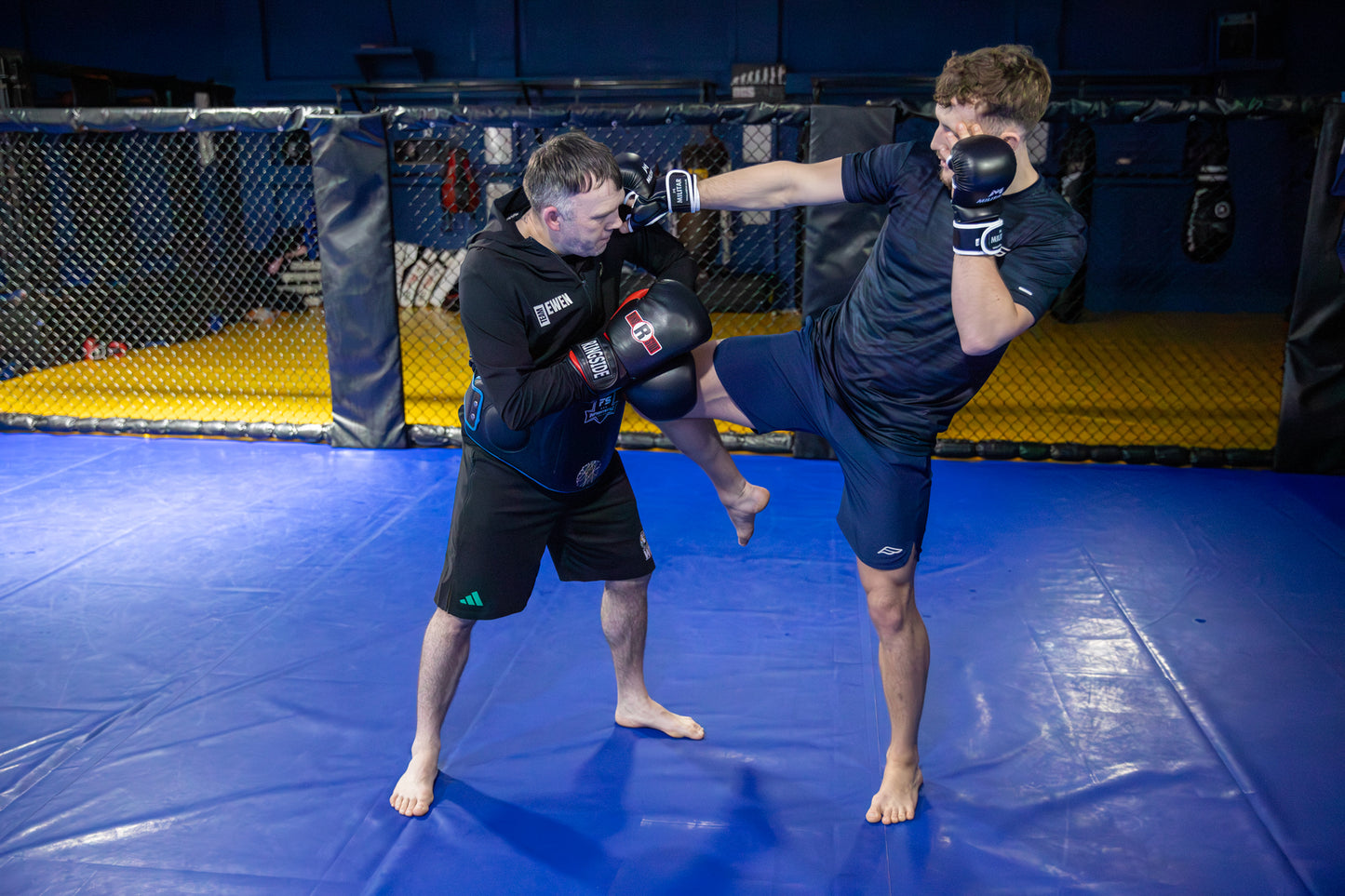

MMA Pressure Striking for Fighters – The Higher Level Counter System with James Doolan
Learn MMA pressure striking for fighters with James Doolan and discover how elite athletes use pressure to create reactions — then punish those reactions with counters, second-phase attacks, body shots, calf kicks and fight-finishing knees.
Pressure in MMA isn't simply about constantly moving forward.
Against an experienced opponent, reckless pressure creates opportunities to be countered, taken down or caught entering range.
Effective pressure has to be intelligent.
You need to understand what reaction you're trying to create, what your opponent is likely to do next and how you can exploit that response.
That's the foundation of MMA Pressure Striking for Fighters – The Higher Level Counter System.
In his fourth full-length Warrior Collective instructional, internationally respected MMA coach James Doolan reveals how he develops pressure and counter striking with the professional fighters at Higher Level MMA in Scotland.
Working extensively with undefeated Higher Level prospect Sean Clancy Jr, James breaks down a systematic approach to pressure fighting built specifically around the realities of MMA.
Rather than simply attacking harder or throwing more combinations, you'll learn how to create predictable reactions and build your next attack around them.

James Doolan and the Higher Level Approach to MMA
James Doolan is the founder and head coach of Higher Level MMA in Bathgate, West Lothian, one of Scotland's established MMA development teams.
A former professional fighter with a 17-9-2 MMA record, James built his coaching methodology from extensive experience across striking, wrestling and grappling. His competitive career included appearances for Cage Warriors, BAMMA and Cage Rage.
Higher Level subsequently developed fighters who progressed to major international promotions. James has overseen the development of UFC-level athletes including Stevie Ray, Danny Henry and Joanne Wood, while the gym has also produced competitors across Cage Warriors and other major organisations.
But one of the most interesting aspects of James's coaching isn't simply who he has coached.
It's how he coaches them.
His approach is highly systematic. Rather than teaching striking, wrestling and grappling as completely separate subjects, James looks at the problems fighters encounter during live MMA and develops connected frameworks for solving them.
In a September 2026 interview, James specifically discussed this systems-based approach to coaching and his continual search for better ways to develop fighters.
That philosophy runs throughout his entire Warrior Collective series.
And Volume 4 applies it specifically to pressure and counter striking.
MMA Pressure Striking: Creating Reactions
One of the central concepts throughout this instructional is that pressure should have a purpose.
Moving forward alone isn't enough.
Good pressure changes what your opponent feels comfortable doing.
They may:
- retreat towards the cage
- plant their feet to counter
- throw predictable punches
- kick to stop your advance
- shell defensively
- change stance
- attempt to circle away
- level change into wrestling
Each response provides information.
James teaches you how to use that information to determine what comes next.
Instead of thinking:
"I'm going to throw this combination."
You begin thinking:
"I'm going to create this reaction — and attack what that reaction exposes."
That's a fundamentally different approach to MMA striking.

The Higher Level Pressure & Counter System
Throughout the volume, James develops this concept through a series of connected striking problems.
You aren't simply learning individual punches, kicks and knees.
You're learning how to create situations where those techniques become increasingly difficult for an opponent to avoid.
Pressure Counter Fighting
The system begins with pressure itself.
James explains how to move an opponent, occupy space and encourage particular attacks without recklessly walking into their offence.
The objective is to make your opponent feel that they have an opportunity to attack.
But you're already anticipating the response.
This turns pressure into a method of drawing attacks that can be countered, rather than simply forcing your own offence.
Second-Phase Attacks and Counters
Your first attack won't always work.
Against experienced fighters, it probably shouldn't.
They'll defend, move, counter or change position.
James therefore places considerable emphasis on what he calls second-phase attacks.
Instead of treating the opponent successfully defending your first attack as the end of the exchange, their defence becomes the beginning of your next opportunity.
You attack.
They respond.
You attack the response.
This is one of the most important concepts in the entire instructional.
Training the System with Sean Clancy Jr
A major strength of this volume is that James demonstrates and coaches the material with Sean Clancy Jr, one of the leading fighters developed within the Higher Level system.
Clancy operates out of Higher Level in Bathgate and has developed under James Doolan. Sherdog highlighted him as a notable prospect and described Higher Level as the camp where he sharpens his skills under James.
That makes Sean particularly relevant to this instructional.
You're not watching James demonstrate an abstract striking theory with a passive partner.
You're seeing concepts being coached with an athlete who has developed within the same Higher Level methodology the instructional is teaching.
This provides an important window into how James actually develops professional fighters.
From Technique to Professional MMA Training
The volume doesn't stop with James explaining individual techniques.
You also get to see elements of the system brought into Higher Level professional training.
That's valuable because there is a huge difference between understanding a technique intellectually and building an athlete capable of applying it against resistance.
James's wider approach increasingly centres around creating fighters who can recognise and solve problems rather than simply reproduce techniques.
His recent public discussion of coaching specifically highlights a systems-based approach and his continued interest in improving training methodology.
This volume gives coaches an opportunity to study not just what James teaches, but how the individual concepts can fit into a larger fighter-development process.

What You'll Learn
Inside MMA Pressure Striking for Fighters – The Higher Level Counter System, James covers:
- Intelligent pressure for MMA
- Creating predictable reactions
- Pressure counter fighting
- Drawing attacks to counter
- Second-phase attacks
- Second-phase counters
- Continuing offence after the initial exchange
- Setting up body punches
- Attacking the body safely in MMA
- Countering with body shots
- Catching body kicks
- Countering immediately from caught kicks
- Outside calf-kick setups
- The Higher Level outside calf-kick framework
- Inside calf kicks
- Disrupting stance and balance
- Layering leg attacks with punches
- Creating finishing opportunities
- Fight-finishing knees
- Professional MMA training methods
- Applying the complete system against resistance
- Bonus training content

This Isn't Kickboxing with Smaller Gloves
One of the biggest mistakes fighters can make is assuming that good striking automatically transfers unchanged into MMA.
It doesn't.
Smaller gloves change defence.
Takedowns change stance.
Wrestling changes combinations.
The cage changes movement.
The threat of level changes affects pressure.
And every time you commit to an attack, you potentially expose another phase of the fight.
James's system is therefore built for MMA from the beginning.
You learn to pressure while remaining aware of grappling threats.
You learn to attack without assuming your first strike will land.
You learn to counter an opponent's response.
And you learn to build offence through multiple phases rather than relying on isolated combinations.

Designed for MMA Coaches as Much as Fighters
If you're an MMA coach, The Higher Level Counter System provides far more than another collection of combinations to put on pads.
The real value lies in the underlying coaching questions:
What reaction are we trying to create?
What does the athlete do if the first attack fails?
How do we build second and third phases?
How do we develop decision-making rather than memorised combinations?
How do we make pressure intelligent rather than reckless?
How do we integrate striking with the wider threats present in MMA?
Those concepts can be taken directly into your own coaching environment and developed into drills, pad work, partner exercises, situational sparring and live training.
That makes the instructional particularly useful for coaches trying to move beyond simply teaching techniques towards developing more adaptable MMA fighters.
Who Is This Instructional For?
MMA coaches who want a systematic framework for developing pressure, reactions, counters and layered attacks.
Competitive MMA fighters who need their striking to function against experienced opponents who defend and counter intelligently.
Intermediate and advanced athletes wanting to understand how attacks can be connected across multiple phases.
Striking coaches working with MMA athletes who want to adapt their existing Boxing, Muay Thai or Kickboxing knowledge to the tactical demands of MMA.
Developing fighters who can perform techniques successfully in drills but struggle to reproduce them consistently against resisting opponents.
And anyone who wants to understand how one of Scotland's established MMA teams develops its striking systems.
Volume 4 of the James Doolan Higher Level MMA Series
This is James Doolan's fourth full-length Warrior Collective instructional and the latest release in a series that provides an increasingly detailed look at his approach to developing complete MMA fighters. Warrior Collective currently carries all four volumes.
Volume 1 – MMA Drills for Elite Level Fighters: Chaining Attacks
Understand how James connects striking, wrestling, takedowns, mat returns and ground control through progressive MMA drills.
Volume 2 – MMA Striking Drills for Fighters: The Higher Level System
Build the foundations of MMA-specific striking through movement, kicking, feints, distance control, defence and cage positioning.
Volume 3 – The Twisting Body Lock System: Higher Level MMA Training
Develop the wrestling phase through body locks, cage control, chained takedowns, back exposure, mat control and leg riding.
Volume 4 – MMA Pressure Striking for Fighters: The Higher Level Counter System
This instructional.
Learn how to pressure opponents, create reactions and use those responses to build counters, second-phase attacks and finishing opportunities.
Taken together, the four volumes show something much bigger than four collections of techniques.
They reveal different parts of the Higher Level MMA coaching methodology.
Build Pressure That Creates Opportunities
The defining principle of this volume isn't simply aggression.
It's purposeful pressure.
Pressure an opponent into making decisions.
Recognise those decisions.
Attack the resulting openings.
If the first attack fails, move into the second phase.
If their defence changes, change with it.
Use punches to expose kicks.
Use kicks to disrupt stance.
Attack the body to alter the guard.
And when the accumulated reactions finally create the opportunity, finish the exchange.
That's what separates a collection of striking techniques from a genuine fighting system.

Frequently Asked Questions
What is pressure striking in MMA?
Pressure striking in MMA is the use of controlled forward pressure to restrict an opponent's options and encourage predictable reactions.
Effective pressure does not mean simply walking forward and throwing more strikes. James Doolan teaches fighters to use positioning, movement and offensive threats to influence what an opponent does next. Those reactions can then create opportunities for counters, follow-up attacks and more damaging strikes.
How do you pressure an opponent in MMA without getting countered?
Good pressure requires you to remain defensively responsible while taking away an opponent's space.
Rather than constantly attacking, James teaches fighters to use pressure to encourage particular responses. By anticipating likely punches, kicks, movement or defensive reactions, you can prepare the appropriate counter instead of simply exchanging strikes. This makes pressure a tactical tool rather than uncontrolled aggression.
What is pressure counter fighting?
Pressure counter fighting combines forward pressure with counter striking.
Instead of waiting for an opponent to initiate every exchange, you use pressure to help provoke the attack or reaction you want. This can make their responses easier to anticipate. James Doolan's Higher Level system explores how fighters can create these situations and then counter the reactions their pressure produces.
What are second-phase attacks in MMA?
A second-phase attack is the offence that follows after an opponent reacts to or defends your initial attack.
For example, your first combination may force an opponent to block, retreat, counter or change position. Rather than considering the exchange finished, James teaches fighters to recognise that response and immediately build the next attack around it.
The objective is to develop layered offence rather than isolated combinations.
How do you improve second and third attacks in MMA?
Start by moving beyond fixed combinations and paying attention to the reactions created by your first attack.
Instead of always predetermining every strike, training can expose fighters to different defensive responses and require them to recognise what becomes available next. James's system develops this relationship between the initial attack, the opponent's response and the subsequent phase of offence.
This helps make combinations more adaptable against resisting opponents.
How should body punches be used in MMA?
Body punches can be extremely effective in MMA, but they need to account for takedowns, knees, counters and the smaller gloves.
Rather than simply dropping level and attacking the body, James shows how body shots can be created through positioning, pressure and an opponent's reactions. They can then become part of a wider offensive sequence, helping to change an opponent's guard and create openings elsewhere.
Can body shots be used as counters in MMA?
Yes. An opponent's own attack can expose opportunities to counter the body.
James teaches fighters to recognise changes in posture and position during offensive exchanges and use those moments to attack exposed targets. This means body punching becomes both an attacking and counter-attacking weapon rather than something used only at the beginning of a combination.
How do you use calf kicks effectively in MMA?
Calf kicks can disrupt an opponent's stance, movement and ability to generate force, but their effectiveness depends heavily on timing and setup.
James incorporates both outside and inside calf kicks into a broader MMA striking system. Instead of throwing them as isolated attacks, fighters learn how leg attacks can interact with pressure, punches, movement and subsequent phases of offence.
What is the difference between an inside and outside calf kick?
An outside calf kick attacks the outside of the opponent's lead leg, while an inside calf kick attacks from the opposite side.
The different targets, angles and positions can produce different reactions in an opponent's stance and balance. James teaches both as parts of a wider framework, allowing fighters to attack the base from different positions and connect calf kicks with their other striking attacks.
Why are reactions important in MMA striking?
Experienced opponents rarely remain stationary and allow techniques to land uncontested. They move, defend, counter, change stance, wrestle or attempt to escape.
Those reactions provide information.
James Doolan's Higher Level approach teaches fighters to recognise what their attacks cause an opponent to do and use that information to determine what comes next. This develops adaptable fighters who can solve problems during live exchanges rather than relying entirely on predetermined combinations.
How is pressure striking different from aggressive fighting?
Aggressive fighting describes the intent to attack and impose yourself on an opponent. Effective pressure striking is more calculated.
A pressure fighter can sometimes create opportunities without throwing at all. Positioning, feints and forward movement can restrict an opponent's choices and encourage predictable responses.
James's system focuses on making pressure purposeful: create the reaction first, recognise it and then select the appropriate attack.
Below is an extract from the volume. This clip is from Video 1 - Pressure Counter Fighting