

15 of the Best Dutch Kickboxing Gyms in the Netherlands
15 of the Best Dutch Kickboxing Gyms in the Netherlands
The Netherlands has played an extraordinary role in the development of modern Kickboxing.
From the pioneering influence of gyms such as Mejiro and Vos Gym through to the teams producing today's elite GLORY, K-1 and international Kickboxing talent, Dutch gyms have developed a reputation for hard training, high-volume combinations, intelligent pressure, technical pad work and some notoriously demanding sparring.
Through Warrior Collective I've been fortunate enough to visit, train and film inside many of these gyms, working with some of the coaches responsible for developing Dutch Kickboxing over several generations.
My connection with training in Holland actually goes back much further than Warrior Collective.
I first moved to the Netherlands when I was 17 and spent much of my spare time seeking out Martial Arts gyms and experiencing Dutch training culture for myself.
I worked in the day labouring on the old boat houses around Dordrecht and, whenever I wasn't working, tried to train as much as possible.
I was living around Eindhoven without a driving licence or much money, so an old bicycle became my transport to local Muay Thai, Kickboxing and Taekwondo gyms.
At weekends I'd often get the train to Amsterdam and find somewhere else to train.
It was a serious education.
I arrived thinking I was already a reasonably competent striker.
A few Dutch training sessions quickly corrected that assumption.

Returning to Holland with Warrior Collective
Fast forward several decades and I've since returned to the Netherlands countless times through Warrior Collective.
This time I've been able to visit gyms as a coach, filmmaker and student rather than simply the enthusiastic 17-year-old trying to survive the rounds.
I've filmed with some of the most respected Dutch Kickboxing coaches and fighters in the world.
I've watched how different gyms structure training.
I've experienced their pad work.
Their partner drills.
Their sparring.
Their fighter sessions.
And perhaps most interestingly, I've seen just how different the individual interpretations of Dutch Kickboxing can actually be.
There isn't one Dutch Kickboxing system.
Mike's Gym doesn't train exactly like Vos Gym.
Vos doesn't train exactly like SB Gym.
Mejiro has its own identity.
Andy Souwer has his.
Lucien Carbin has his.
And the newer generation of Dutch coaches continues to evolve the sport.
That's part of what makes travelling around the Netherlands to train so valuable.
You're not visiting fifteen versions of the same gym.
You're experiencing fifteen different interpretations of one of the world's great striking cultures.
So, having originally published a list of ten, I've now completely revisited it

15 of the Best Dutch Kickboxing Gyms in the Netherlands
-
Mike’s Gym - Amsterdam
-
Hemmers Gym - Breda
-
Vos Gym - Amsterdam
-
Mousid Gym - Amsterdam
-
SB Gym - Utrecht
-
Mejiro Gym - Amsterdam
-
The Colosseum Gym - Utrecht
-
Team Holzken - Helmond
-
Andy Souwer Kickboxing University - Den Bosch
-
Carbin All Style / Bien Fighters - Amsterdam
-
ARJ Gym - The Hague
-
Bonjasky Gym - Almere
-
El Otmani Gym - Amsterdam
-
Maji Art of Fight Gym - Eindhoven
-
CSA Holland - Helmond
There is no single “best” Dutch Kickboxing gym in the Netherlands for everyone. Your ideal choice depends on your experience, whether you fight and the style of Kickboxing you want to develop.
How I Chose the Best Dutch Kickboxing Gyms
This isn't intended as a ranking from first to fifteenth
Instead, I've looked at:
Quality of coaching
Training environment
History
Current relevance
Quality of training partners
Accessibility to visiting Martial Artists
My personal experience with them
and, perhaps most importantly:
Is there something distinctive you can learn by training there?
Let's get into it.

Mike's Gym – Amsterdam
Few names are more closely associated with modern Dutch Kickboxing than Mike's Gym.
Founded by Mike Passenier, the Amsterdam team has spent decades producing and developing elite fighters capable of competing at the highest levels of Kickboxing and MMA.
Names associated with the gym over the years include:
Serhiy Adamchuk
and numerous fighters who have competed across K-1, GLORY and MMA.
But what makes Mike's Gym interesting isn't simply the names on the wall.
It's the culture.
Mike has built a reputation around:
Discipline
Pressure
Physical preparation
Teamwork
and developing fighters capable of imposing themselves on opponents.
There's an intensity to the Mike's Gym approach that fits many people's image of traditional Dutch Kickboxing perfectly.
Heavy Boxing combinations.
Low kicks.
Pressure.
Conditioning.
Hard rounds.
And fighters expected to be physically and mentally prepared for competition.

Why Visit Mike's Gym?
If you want to experience the harder, pressure-based side of Dutch Kickboxing culture, Mike's Gym remains one of the obvious destinations.
The facility itself is substantial, with dedicated striking areas alongside Strength & Conditioning provision.
If you're hoping to access professional training rather than general classes, contact the gym beforehand.
Don't simply arrive expecting to jump into a professional fighter session.
→ Visit Mike’s Gym
Hemmers Gym – Breda
Few Dutch Kickboxing gyms carry more history than Hemmers Gym.
Its lineage runs through Cor Hemmers, Golden Glory and, of course, one of the most iconic foreign fighters ever to compete extensively in Thailand:
Today, that legacy continues through Nick Hemmers.
And that's what makes Hemmers particularly interesting.
This isn't simply a museum celebrating a previous generation of Dutch fighters.
It's a living continuation of that coaching lineage.
Over the years, elite fighters associated with the team have included athletes such as Marat Grigorian and Jamal Ben Saddik, alongside numerous other international-level Kickboxers.

Why Visit Hemmers Gym?
There are gyms where you can almost feel the history of Dutch Kickboxing as soon as you walk through the door.
Hemmers is one of them.
But the reason to visit isn't nostalgia.
It's the opportunity to experience how knowledge is transferred across generations.
Cor influenced Nick.
Nick developed his own coaching identity.
And the system continued evolving.
For anybody interested in understanding where Dutch Kickboxing came from as well as where it's going, Hemmers remains an important destination.
→ Visit Hemmers Gym
Vos Gym – Amsterdam
If you're interested in the history of Dutch Kickboxing, Vos Gym is essential.
Originally founded by Johan Vos, the gym became one of the key academies involved in developing the Dutch style.
Its lineage includes legendary fighters and coaches, with Ivan Hippolyte becoming one of the most important figures responsible for carrying that knowledge forward.
I've spent a considerable amount of time filming with Ivan through Warrior Collective.
And his approach is fascinating.
There's the classic Dutch emphasis on:
Boxing combinations
Low kicks
High-volume partner drills
Give-and-take training
and pressure.
But Ivan also places enormous emphasis on intelligent counter fighting.
Don't simply attack.
Make the opponent commit.
Read the attack.
Defend.
Counter.
Then take over the exchange.
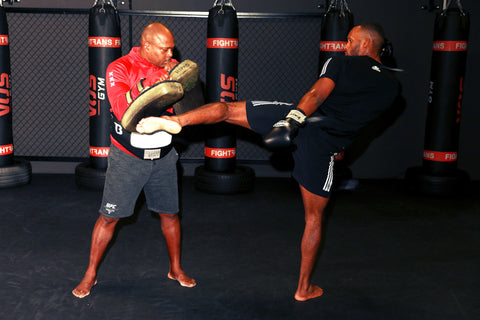
Why Visit Vos Gym?
If you want to understand traditional Dutch combination training and counter fighting, Vos belongs near the top of your travel list.
You're not simply visiting a gym.
You're stepping into one of the places that helped shape the sport.

Train with Ivan Hippolyte on Warrior Collective
Ivan's Warrior Collective instructionals include:
K-1 Kickboxing – Dominating the Fight
The Vos Gym Kickboxing System – High Volume Striking
and
Dutch Kickboxing Counter Systems – The Vos Gym Method
Together they provide a detailed insight into one of the most influential Dutch Kickboxing coaching lineages.
→ Explore Ivan Hippolyte's Dutch Kickboxing Instructionals
WATCH: IVAN HIPPOLYTE DUTCH KICKBOXING TRAINING
→ Visit Vos Gym
Mousid Gym – Amsterdam
Mousid Gym has never had quite the same international name recognition as Mike's, Mejiro or Vos.
Among people who understand Dutch Kickboxing, however, it has long commanded enormous respect.
Founded by former Dutch, European and World Champion Mousid Akhamrane, the gym has developed fighters including:
Hafid El Boustati
and Mosab Amrani.
This is exactly the type of gym I enjoy visiting.
It isn't about enormous facilities or marketing.
It's about the standard of coaching and the people on the mat.

Why Visit Mousid Gym?
Mousid is particularly interesting if you're looking for a more traditional fight-gym experience.
Good coaching.
Hard training.
Technical partners.
And decades of experience behind the system.
Sometimes that's all a serious fighter actually needs.
WATCH: MOUSID AKHAMRANE DUTCH KICKBOXING TRAINING
→ Visit Mousid Gym
SB Gym – Utrecht
If I were writing this article purely on current relevance, SB Gym would have one of the strongest arguments anywhere on the list.
Head coach Said El Badaoui has built SB Gym into one of the major centres of modern Dutch Kickboxing.
And I've been fortunate enough to spend considerable time with Said over the years through Warrior Collective.
What interests me most about Said isn't simply the calibre of fighter he works with.
It's how he teaches.

Elite Fighters and an Accessible Gym
SB Gym has become home to athletes competing across some of the biggest combat-sports organisations in the world.
But one of the things I like about the gym is that this hasn't turned it into somewhere exclusively for professionals.
There's still a genuine community around it.
Beginners.
Recreational students.
Young athletes.
Competitive fighters.
World-class professionals.
They all exist within the same wider environment.
Why Visit SB Gym?
If you want to understand what modern Dutch Kickboxing coaching looks like rather than simply recreating the training of the 1990s, SB Gym should be high on your list.
The combination of elite fighters, creative coaching and a welcoming environment makes it one of my favourite places to visit in the Netherlands.

Train with Said El Badaoui on Warrior Collective
Said's Warrior Collective material provides a much deeper look at the training methodology behind SB Gym.
Dutch Kickboxing Training Drills - Fighter Development
Dutch Kickboxing Combination Systems - Building Elite Fighters
If you can't get to Utrecht, this is the next best way of understanding how he develops fighters.
→ Explore Said El Badaoui's Dutch Kickboxing Instructionals
WATCH: SAID EL BADAOUI DUTCH KICKBOXING TRAINING
→ Visit SB Gym
Mejiro Gym – Amsterdam
You can't write seriously about Dutch Kickboxing without talking about Mejiro Gym.
Its history is fundamental to the sport.
Founded by Jan Plas after his exposure to Japanese Kickboxing, Mejiro became one of the key environments from which Dutch Kickboxing evolved.
Its lineage includes extraordinary names such as:
and Andy Souwer.
Today, Andre Mannaart remains one of the figures most closely associated with maintaining that identity.
I've always enjoyed my time with Andre.
He's direct.
Old school.
Not particularly interested in hype.
The philosophy is relatively simple:
Turn up.
Train properly.
Work hard.
Respect the gym.

Why Visit Mejiro?
Because if you want to understand Dutch Kickboxing, you should understand its roots.
Mejiro isn't simply a famous name.
The gym helped create the technical blueprint that influenced generations of fighters.
The classic Dutch combination of Western Boxing, powerful low kicks, structured partner drills and relentless repetition owes a great deal to places like this.
→ Visit Mejiro Gym
The Colosseum Gym – Utrecht
Utrecht has developed into an excellent destination for Kickboxing, and The Colosseum Gym remains one of its strongest training environments.
One of the things that has always made Colosseum interesting is the variety of high-level fighters passing through the gym.
That creates an environment where you're exposed to different styles rather than simply working with the same small group every week.
The gym has also continued developing its broader performance infrastructure.
Kickboxing remains central, but the facility now supports Boxing, MMA, Strength & Conditioning and other areas of athlete development.

Why Visit The Colosseum?
For experienced fighters, the attraction is straightforward:
Training partners.
The Netherlands has always benefited from fighters travelling between gyms for sparring.
Colosseum represents that culture particularly well.
If you get the opportunity to attend the right session, you may find an extraordinary collection of talent sharing the same mat.
→ Visit Colosseum Gym
Team Holzken – Helmond
There aren't many fighters who represent modern Dutch Kickboxing more recognisably than Nieky Holzken.
Nieky's fighting style combines several qualities I particularly enjoy:
Excellent Boxing
Combination striking
Pressure
Body punching
Low kicks
and the ability to remain dangerous while moving forward.
Alongside Sjef Weber, Team Holzken has created a training environment built around that experience.

Why Visit Team Holzken?
This is an especially interesting destination if your own style is heavily Boxing orientated.
One of the recurring characteristics of Dutch Kickboxing is its ability to connect high-level Boxing combinations with kicking attacks.
Nieky is one of the best examples of that.
Rather than:
Punch. Stop. Kick.
you see:
Punch → punch → create reaction → kick
or:
Attack body → opponent changes guard → attack another target.
That's the difference between knowing techniques and understanding combination fighting.
→ Visit Team Holzken
Andy Souwer Kickboxing University – Den Bosch
Andy Souwer is another fighter whose name is inseparable from Dutch Kickboxing.
A two-time K-1 World MAX Champion and multiple Shoot Boxing World Tournament Champion, Andy competed against many of the defining fighters of his generation.
What makes him particularly interesting now is the transition from fighter to coach.
Knowing how to fight doesn't automatically mean you know how to teach.
Andy has spent years developing a structured approach for transferring his own understanding to other athletes.

Why Visit Andy Souwer Kickboxing University?
For anybody interested in classic Dutch combination fighting, this is an obvious destination.
Andy understands:
Pressure
Volume
Combination construction
Defence
Counters
and how those components need to interact.
You're learning from somebody who has actually applied those concepts against the best fighters in the world.
Train with Andy Souwer
His full-length Warrior Collective instructional:
The Dutch Kickboxing System – Training Fighters to Win
looks at how Andy structures the development of fighters using the same concepts that underpinned his own career.
WATCH: ANDY SOUWER DUTCH KICKBOXING TRAINING
→ Visit Andy Souwer Kickboxing University
Carbin All Style / Bien Fighters – Amsterdam
Lucien Carbin represents another fascinating branch of the Dutch striking tree.
His background isn't limited to Kickboxing.
It includes influences from:
Kyokushin Karate
Savate
and other striking systems.
That history is visible in his coaching.
Carbin All Style doesn't simply look like somebody copied a standard Dutch Kickboxing syllabus.
There's movement.
Unusual kicking mechanics.
Different rhythms.
Different angles.
And technical ideas you may not encounter elsewhere.
Lucien has also worked with elite fighters including Alistair Overeem, Tyrone Spong and Gilbert Yvel.

Why Visit?
Because travelling to train should expose you to ideas you aren't already getting at home.
Lucien offers exactly that.
If you've trained conventional Kickboxing for years, Carbin All Style may force you to think about familiar problems differently.
Train with Lucien Carbin
Warrior Collective features two full-length instructional volumes exploring his methodology:
Carbin All Style Dutch Kickboxing System
and
Dutch Kickboxing Drills – Carbin All Style
WATCH: LUCIEN CARBIN DUTCH KICKBOXING TRAINING
→ Visit Carbin All Style / Bien Fighters
ARJ Gym – The Hague
One of the most obvious additions to this updated list is ARJ Gym in The Hague.
Under head coach Mike Polanen, ARJ has developed an extremely impressive current roster.
That roster has included fighters such as:
Endy Semeleer
Michael Boapeah
Levi Rigters
and Tarik Khbabez.
That alone makes ARJ interesting to serious Kickboxing fans.
But the important thing for somebody actually wanting to visit is that the gym isn't built exclusively around professionals.
There are pathways for:
Beginners
Recreational Kickboxers
Advanced students
and competitive fighters.

Why Visit ARJ Gym?
ARJ represents another example of where Dutch Kickboxing is right now.
That's important.
If you only visit the legendary gyms of the 1980s and 1990s, you'll learn about Dutch Kickboxing history.
If you visit places such as ARJ and SB Gym, you also see how the system continues to evolve around today's fighters and today's rules.
For coaches in particular, comparing those generations is incredibly valuable.
→ Visit ARJ Gym
Bonjasky Academy – Almere
If you've followed Kickboxing for any length of time, Remy Bonjasky needs very little introduction.
The three-time K-1 World Grand Prix Champion was one of the defining heavyweights of the golden era of K-1.
But Bonjasky Academy deserves inclusion for more than the name above the door.
Remy has taken his competitive experience and built a much broader Martial Arts academy around it.
The academy caters for recreational students as well as competitive athletes and includes Kickboxing alongside Boxing, MMA, fitness and Strength & Conditioning.

Why Visit Bonjasky Academy?
This is particularly interesting if you're a coach or gym owner as well as a fighter.
You're not simply looking at how an elite athlete trains.
You're looking at how somebody takes decades of elite competitive experience and turns it into an academy capable of serving:
Children
Beginners
Recreational students
and competitive fighters.
That's a different challenge entirely.
And one Remy has now been working on for many years.
→ Visit Bonjasky Academy
El Otmani Gym – Amsterdam
El Otmani Gym is another name with deep roots in the Amsterdam Kickboxing scene.
Based in Slotervaart in Amsterdam-West, the gym was founded by the late Nourdin El Otmani, a seven-time Kickboxing World Champion and Muay Thai World Champion who went on to dedicate himself to coaching and developing the next generation.
Over the years, El Otmani Gym has been associated with fighters including:
Mohamed “Hamicha” Mezouari
Ilias Bulaid
Ertugrul Bayrak
and Soufian El Haji.
But El Otmani has never been exclusively about producing competitive fighters.
The gym has built its identity around:
Kickboxing
Bag training
Brazilian Jiu Jitsu
Fitness
and training for different ages and experience levels.
Respect, discipline and perseverance remain central to the philosophy of the gym.

Why Visit El Otmani Gym?
El Otmani represents another important side of Dutch Kickboxing culture.
This isn't simply a professional fight team built around whichever elite fighters happen to be competing right now.
It is a community gym with genuine competitive pedigree, where Kickboxing has been used both to develop high-level fighters and to positively influence generations of people from the surrounding area.
Nourdin El Otmani's influence on the gym and Amsterdam Kickboxing community forms an important part of that story.
For anybody interested in experiencing Dutch Kickboxing beyond the most internationally famous Amsterdam gyms, El Otmani is well worth knowing about.
→ Visit El Otmani Gym
MAJI Art of Fight – Eindhoven
This is perhaps the least traditional inclusion on the list.
And that's exactly why I've included it.
MAJI Art of Fight in Eindhoven represents a fascinating meeting point between Dutch and Japanese Kickboxing.
The gym is led by Tai Terada, whose approach I've now had the opportunity to explore extensively through Warrior Collective.
Tai's system draws heavily on the Japanese side of modern Kickboxing.
That means techniques and concepts such as:
Calf kicks
Mikazuki kicks
Kyokushin-influenced kicking
Unorthodox low kicks
Japanese knees
Range manipulation
and highly structured Japanese-style pad work.
His younger brother Takumi Terada has competed at world-class K-1 level, while Tai has also spent considerable time working alongside elite Japanese fighters.

Why Does a Japanese Kickboxing Gym Belong on a Dutch List?
Because this brings the history full circle.
Dutch Kickboxing itself wasn't created in isolation.
Japanese Kickboxing and Kyokushin Karate were fundamental influences on its development.
Dutch coaches took those ideas, mixed them with Western Boxing and Muay Thai, and developed something distinctive.
Now we're seeing Japanese and Dutch Kickboxing influence each other again.
MAJI gives you an opportunity to experience that evolution firsthand.

Train with Tai Terada
Warrior Collective features Tai's Japanese Kickboxing series covering both his technical system and his approach to pad work.
Japanese Kickboxing - Learning the Art of Fighting
Japanese Kickboxing - Pad Work for Modern Fighters
If you've spent years training conventional Dutch Kickboxing, these volumes provide some particularly interesting contrasts.
→ Explore Tai Terada's Japanese Kickboxing Series
WATCH: TAI TERADA JAPANESE VS DUTCH KICKBOXING TRAINING
→ Visit Maji Art of Fight Gym
Another gym I'd add to the updated list is Combat Sports Academy Holland (CSA Holland) in Helmond.
At the centre of CSA is head coach Marko van den Broek, whose experience across different areas of combat sports has helped shape the academy into something broader than a conventional Dutch Kickboxing gym.
Rather than looking at Kickboxing completely in isolation, Marko's approach reflects the crossover between striking, Grappling, Wrestling and the wider combat-sports world.
CSA has more than 25 years of experience behind it and offers training across:
Kickboxing
Boxing
MMA Grappling
MMA Wrestling
and Combat Sambo.
That mixture is significant.
One of the things that has always made the Netherlands such an interesting place to train is the amount of crossover between different combat sports.
Dutch Kickboxing itself didn't develop in isolation.
Kyokushin Karate.
Japanese Kickboxing.
Western Boxing.
Muay Thai.
And later MMA.
All have influenced how Dutch fighters train and compete.
Marko van den Broek's work at CSA reflects that broader approach, with the academy providing an environment where striking can sit alongside Wrestling, Grappling and other combat systems rather than existing as a completely separate discipline.

Why Visit CSA Holland?
CSA is particularly interesting for Martial Artists and coaches who want to look beyond one interpretation of Dutch Kickboxing.
Under Marko van den Broek, the academy has developed a genuinely multidisciplinary approach to combat sports while retaining Kickboxing as an important part of its identity.
For somebody interested in how different fighting systems can influence one another – and how striking changes when Wrestling, Grappling and MMA enter the equation – CSA offers a different perspective from many of the more specialist Kickboxing gyms on this list.
That makes it a worthwhile stop when exploring the wider Dutch combat-sports scene.
WATCH: CSA HOLLAND DUTCH KICKBOXING TRAINING
→ Visit CSA Holland
What Makes Dutch Kickboxing Different?
After spending so much time training and filming around the Netherlands, one of the things I've learned is that the term Dutch Kickboxing can be misleading.
There isn't one universally agreed Dutch style.
But there are characteristics you repeatedly encounter.
Boxing into Kicks
Rather than treating punching and kicking as separate phases, Dutch fighters are particularly good at connecting them.
A classic example is:
Boxing combination → low kick
But sophisticated fighters take this much further.
Hands create reactions.
Reactions create kicking opportunities.
Kicks create openings for the hands.
Everything connects.
High-Volume Combination Work
Dutch gyms often place enormous emphasis on combinations.
Not simply:
Jab → cross → low kick.
But extended sequences where fighters learn to maintain balance and pressure across multiple attacks.
Give-and-Take Drills
This is one of the defining Dutch training methods.
Partners use their gloves and bodies to provide targets while taking turns attacking, defending and countering.
Done properly, it allows fighters to accumulate enormous numbers of repetitions while developing:
Defence
Combination flow
Counters
Footwork
Conditioning
and rhythm.
Low Kicks
Dutch Kickboxing became famous for devastating low kicks.
But the important thing isn't simply kicking hard.
It's how the kick is connected to the Boxing.
Punches occupy the guard.
Pressure limits movement.
Then the low kick lands.
Pressure
Many Dutch systems place considerable emphasis on taking space from opponents.
That doesn't necessarily mean recklessly walking forward.
Good pressure is intelligent.
You control exits.
Create reactions.
Force predictable responses.
Then punish them.
What About Dutch Hard Sparring?
Dutch Kickboxing has a long-standing reputation for hard sparring, and there's certainly some truth behind it. I've experienced plenty of extremely demanding rounds in Holland myself.
However, don't assume that walking into a Dutch gym means everybody is going to try to knock you out.
Training cultures vary enormously between gyms, classes and competitive teams. If you're visiting, communicate with the coaches, understand which sessions are appropriate for your experience and don't assume that a professional fighter session is suitable simply because it's on the timetable.
There was a period where visiting certain Dutch gyms meant accepting that sparring could become significantly harder than you might be accustomed to elsewhere.
But I wouldn't advise anybody travelling to Holland to arrive thinking:
“Dutch Kickboxing means I need to have a gym war.”
Training cultures evolve.
Gyms differ.
Sessions differ.
And even within the same gym, professional fighter sparring and recreational technical sparring can be completely different experiences.
If you're visiting:
Speak to the coach.
Explain your experience.
Ask which session is appropriate.
Respect the gym.
Control your ego.
And don't confuse being a good training partner with proving how tough you are.
The goal is to learn.
Is the Netherlands Good for Beginner Kickboxers?
Absolutely—but choose your gym and class carefully.
When I first wrote this article, I suggested beginners might not get the most from travelling to Holland.
I'd soften that considerably now.
Many Dutch academies have become far more structured.
Gyms such as SB Gym, ARJ and Bonjasky Academy explicitly provide training for different ability levels.
That makes the Netherlands much more accessible to recreational Martial Artists than the stereotype might suggest.
However, if the reason you're travelling is specifically to experience an elite fight team or professional session, having a solid technical base first will obviously allow you to gain much more from it.
Why Train Dutch Kickboxing in the Netherlands?
Coaching knowledge
Generations of Dutch coaches have developed systems specifically around producing competitive Kickboxers.
Training partners
The concentration of experienced amateur and professional fighters is unusually high.
Gym culture
You're experiencing the training methodology where much of modern European Kickboxing developed.
Accessibility
For European visitors in particular, Amsterdam and the wider Netherlands are extremely easy to reach.
Variety
The gyms aren't clones of one another.
Amsterdam vs Utrecht vs the Rest of the Netherlands
One mistake I'd avoid is booking accommodation in central Amsterdam and assuming every gym you want to visit is nearby.
Amsterdam remains hugely important.
You have gyms such as:
Mike's Gym
Vos Gym
Mejiro
Mousid
El Otmani Gym
and the Carbin lineage.
But some of the most interesting modern training is elsewhere.
Utrecht gives you SB Gym and The Colosseum.
The Hague gives you ARJ.
Breda gives you Hemmers.
Helmond gives you Team Holzken and CSA Holland.
Den Bosch gives you Andy Souwer Kickboxing University.
Eindhoven gives you MAJI.
And there are excellent gyms throughout the rest of the country.
Fortunately, the Netherlands is relatively compact and its transport network makes travelling between cities considerably easier than in many other countries.
If you're planning a dedicated Dutch Kickboxing trip, I'd strongly consider visiting several different cities rather than basing the entire experience around Amsterdam.
Which Dutch Kickboxing Gym Should You Visit?
That depends on what you're looking for.
If you want Dutch Kickboxing history, explore:
Mejiro
Vos
Hemmers
and the Carbin lineage.
If you want to experience modern elite fighter development, look particularly at:
SB Gym
ARJ
Mike's Gym
and other teams with current high-level competitors.
If you're interested in combination fighting, consider:
Andy Souwer Kickboxing University
Team Holzken
El Otmani Gym
or Mejiro.
If you're interested in Fight IQ and structured fighter-development drills, SB Gym and CSA Holland are particularly interesting.
If you want to understand the Japanese influence on Kickboxing, visit MAJI.
And if you're a coach rather than simply a fighter, I'd deliberately visit contrasting gyms.
Don't look for confirmation of what you already believe.
Look for differences.
That's where the learning happens.
Learn Dutch Kickboxing Online with Warrior Collective
One of the privileges of building Warrior Collective has been the opportunity to document many of these systems in considerably greater depth than is possible in a short YouTube video.
The Warrior Collective library now includes Dutch and Japanese Kickboxing instructionals from coaches including:
and other elite striking coaches.
The purpose isn't simply to collect techniques.
It's to understand systems.
How does Ivan structure counter fighting?
How does Said develop Fight IQ?
How does Andy construct combinations?
How does Lucien create unusual movement and kicking attacks?
How does Tai's Japanese methodology differ from the Dutch approach?
Those differences are where things become interesting.
→ Explore Kickboxing Training
→ Explore Japanese Kickboxing
Final Thoughts
Dutch Kickboxing has had an enormous influence on my own Martial Arts journey.
From being a 17-year-old cycling around Holland looking for somewhere to train, to returning decades later and filming some of the greatest coaches and fighters in the sport, the Netherlands has repeatedly challenged how I think about striking.
And that's why I'd encourage you not to simply visit the most famous gym on this list.
Visit different ones.
Train somewhere old school.
Then somewhere modern.
Compare Mejiro with SB Gym.
Compare Vos with MAJI.
Compare Andy Souwer's approach with Lucien Carbin's.
Watch how different coaches solve the same problem.
How do they create pressure?
How do they teach defence?
How do they connect punches and kicks?
How do they structure partner drills?
How do they develop fighters?
That's when travelling becomes more than collecting photographs outside famous gyms.
It becomes education.
And ultimately that's the same philosophy behind Warrior Collective.
There is no single perfect way to train.
The value comes from learning from great people, understanding why their methods work and then deciding what belongs in your own Martial Arts.